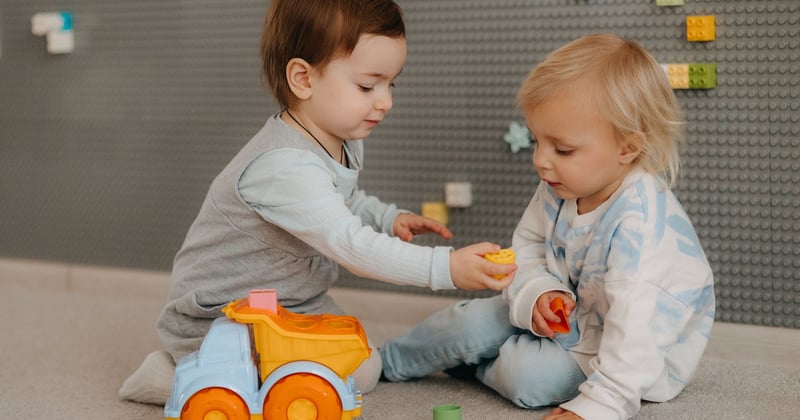
My neighbor once asked me, in a parking lot, whether I thought she was "ruining" her two-year-old by crying in front of him. Why? Because she had just spent twenty minutes sitting on the floor of a play gym, prying a plastic dinosaur out of his tiny fist while he screamed at a volume that made a stranger look up from her phone.
The dinosaur belonged to another child. My neighbor apologized four times. She gave him a lecture about sharing in the parking lot. And then she asked me the question most parents end up asking at some point: how do you teach a toddler to share toys peacefully, without turning the whole thing into a standoff?
Here's the honest answer: for a child under three, sharing is not a moral lesson to be taught but a developmental skill that has to arrive on its own schedule. Your job is not to force it. Your job is to build the scaffolding around it so that when the ability shows up, the child already knows the script.
Key Takeaways
- Sharing is a cognitive milestone that typically emerges between ages 3 and 4, not a behavior you can train into a two-year-old with discipline.
- Turn-taking is the real bridge to sharing. It gives a toddler something concrete and fair to hold onto.
- Forcing a child to hand over a toy teaches compliance, not generosity. The result is often more possessiveness, not less.
- Your model behavior matters more than any lecture. A toddler learns to give by watching you give.
- Most "won't share" behavior in a two or three-year-old is completely normal development. The red flags are about language and social engagement, not sharing itself.
Why your toddler won't share toys, and why that's not a character flaw
A two-year-old refusing to share is not being selfish. He is being developmentally on task.
Before roughly age three, a child's sense of self is still forming, and his possessions are not yet separate from his identity. "Mine" isn't a political statement. It's a boundary marker, one of the first tools a small person has to define who he is in relation to everyone else. The concept of a shared object, one that belongs to nobody in particular and to everybody at once, requires a kind of abstract thinking that simply isn't online yet.
The mental state behind sharing
What changes everything is a cognitive skill called theory of mind. It's the ability to understand that another person has thoughts, feelings, and preferences different from your own. Most children develop a solid version of this somewhere around age four. Until then, the sentence "He wants a turn too" doesn't land. To a two-year-old, "he wants" is a sound that comes out of a face with no interior.
There's also the matter of time. A toddler's sense of "in a minute" is not your sense of "in a minute." When you say "let him have a turn, then it's your turn," what the child hears is forever. The toy is gone. There is no "then." This is why a countdown timer, a physical object you set on the table, works so much better than words. It gives a small person something to see.
So is it normal for a 3 year old to not want to share toys?
Yes, completely. A three-year-old who hoards every toy in his orbit is following the standard developmental playbook. The shift toward genuine sharing usually starts to appear between three and a half and four, and even then it's wobbly. I've watched a four-year-old share a toy truck without hesitation at 9 a.m. and refuse to share the same truck at 4 p.m. when tired and hungry. Developmental skill isn't a light switch. It's a dimmer, and it flickers.
What matters more than whether your three-year-old hands over the train is how he handles the conflict around it. Does he look at the other child? Can he stay in the room without melting down for more than thirty seconds? Does he come to you afterward? Those are the signs you're on track. The toy is just the surface.
What is the 333 rule for toddlers?
You'll see this phrase float around parenting forums, and it's worth being straight with you about it: there is no single officially defined "333 rule" for toddler sharing, and you should be skeptical of any source that presents one with total authority. What the phrase most commonly refers to is a loose set of parenting guideposts, usually something along the lines of giving a child three choices, offering three minutes of warning before a transition, and giving three separate attempts to try a new behavior before pivoting strategy. It's a handy mental shortcut for remembering to stay patient and offer options.
The version that actually helps with a toy conflict, in my experience, is this: when two toddlers lock onto the same object, you give the child holding it three options (turn off the toy, trade for another, or hold it for a count of three more), warn the other child for three minutes that a turn is coming, and then give the situation three solid tries before removing the toy entirely for the day. That last part is the one most parents skip, and it's the one that saves the afternoon.
The value of the rule isn't the number three. It's the structure. Toddlers do better with a script than with a lecture.
Turn-taking: the bridge to sharing that actually works
If you take one thing from this piece, take this: stop teaching sharing and start teaching turn-taking.
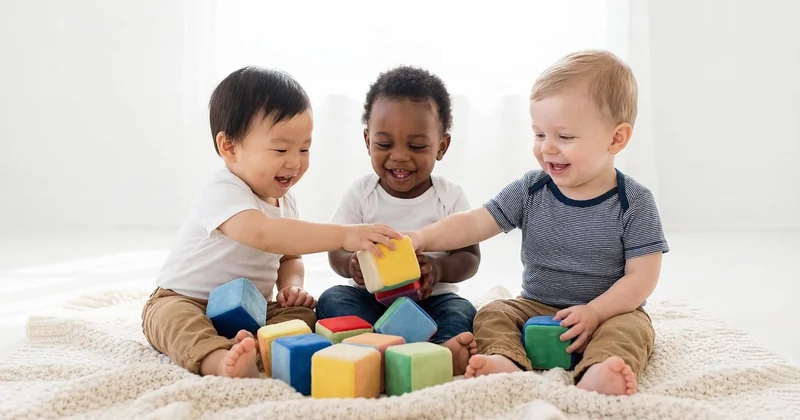
Turn-taking is a skill a toddler can grasp years before sharing. It's concrete. It has a beginning and an end. It involves a physical object passing back and forth, which is something a two-year-old can see and follow. Sharing, by contrast, is abstract. It requires an entire philosophy about other people's inner lives.
Practically, this means swapping your vocabulary. Instead of "you need to share," try "it's his turn, then it's yours." Instead of "let her have it," try "when the timer beeps, it's her turn." Instead of "that's not nice," try "you can hold it until the song ends, then pass it to your brother."
The words matter, but so does the framing. You are not asking the child to extend himself toward another person. You are asking him to follow a rhythm. Rhythm is much easier.
Concrete scripts you can use today
Here are phrases I've actually used with my own kids and with the kids in my playgroup, and they work more often than not:
- "You can hold it until I count to five, then it's her turn. Ready? One, two…"
- "I see you want it. He wants it too. What should we do?" (Wait for an answer. Any answer.)
- "You've had it a long time. Look at his face. What do you think he's feeling?"
- "The truck has to rest for a minute. Let's put it on the shelf and we'll come back."
- "You're a person who takes turns. I can tell." (Compliment the identity, not the action.)
That last one is doing more work than it looks like. A child who is told "you're good at sharing" is more likely to keep behaving that way than one who is told "good job, here's a sticker." The sticker creates a transaction. The identity becomes part of who he is.
Handling the three scenarios every parent faces
The situations below cover almost every toy-sharing conflict a family will hit in the toddler years. Knowing the script in advance is half the battle, especially in public.

When it's siblings fighting over the same toy
Sibling conflicts are harder than playdate conflicts because there's no exit. You live together. The same toy will come up tomorrow, and the day after, and the day after that. The temptation is to adjudicate every fight. Resist it.
The better move: designate one or two toys as personal property, off-limits to the other sibling without permission. This gives each child a small claim to something no one will snatch from them. Give the shared toys a clear rule, usually a turn-taking timer, and let the kids manage it as much as they can. When a fight breaks out, don't hand down a verdict. Ask the older sibling what he thinks the younger one is feeling. Then ask the younger one. Then wait.
The conflicts will continue for years. What changes is whether your children have a script for resolving them. If they do, the fights get shorter and less violent. If they don't, they get longer.
When it's a playdate and the other parent is watching
There's a specific kind of pressure that arrives when another parent is in the room. You feel judged. You feel the need to demonstrate that you're doing something about your child's refusal to share. So you leap in, pry the toy from your child's hand, apologize to the other parent, and deliver a lecture your child will ignore.
This is one of the worst things you can do for the long-term goal. You've just taught your toddler that the way to end a conflict is to take the toy away by force. You've also taught him that being watched changes the game.
Better: prepare the playdate in advance. Before the other family arrives, put the toys your child is most attached to out of sight. Put the shared toys in a basket. Set a timer for turns. When a conflict happens, get down at eye level, name the feeling, and walk the kids through the turn-taking script. If the other parent is uncomfortable, that's their discomfort to manage. Your job is your child.
When the classroom has a different rule
Daycares and preschools often enforce a stricter sharing policy than you do at home, because they have fifteen children and one adult. Don't fight it. The rules in different places can be different, and a toddler can absorb that. The message to give your child is: "At home we take turns. At school they take turns. Both are fine."
If a daycare teacher tells you your child is "struggling to share," take it seriously but not personally. Ask what specific situations are coming up. You may find the issue isn't sharing at all, but transitions, or waiting, or loud rooms. Those are different problems with different fixes.
What actually counts as a red flag at age two
Most "red flag" lists for two-year-olds are a mix of genuine signs and standard toddler behavior dressed up to scare new parents. Let me separate them.
What is not a red flag: refusing to share toys, saying "mine" constantly, having a meltdown when another child touches a preferred object, wanting to carry a favorite blanket or toy everywhere. These are developmentally normal.
What is worth raising with a pediatrician:
- No parallel play by age two, meaning the child doesn't play near other children even in a loose way
- No interest in other children at all, ever
- Frequent physical aggression that doesn't respond to redirection after months of consistent parenting
- Language delay, or loss of words or skills the child previously had
- No back-and-forth engagement (pointing, showing, sharing attention) by eighteen months
The difference between a shy, possessive two-year-old and a child who needs evaluation is usually engagement. Is he aware of other people, even if he's not sharing with them? Does he look at you? Does he notice when another child is upset? Those are the questions that matter, not how many toys he's willing to hand over.
The one thing you can do tonight that changes everything
I'll admit: the first time someone told me that modeling was the most powerful tool for teaching sharing, I rolled my eyes. It sounded like the kind of advice you give when you don't have anything concrete to say. Then I tried it.
For two weeks, I made a point of narrating my own sharing behavior out loud, in front of my sons. "Here, you can have the last piece of bread. I'm sharing it because I love you." "Daddy is going to share his coffee with me. Thank you for sharing, Daddy." "I'm going to share my book with you. Here, you can look at the pictures while I finish."
Within about ten days, my older son started doing the same thing back, unprompted. He'd hand a cracker to his brother and announce, "I'm sharing." Not because I told him to. Because he'd watched me do it and something clicked. It was the fastest behavioral shift I've seen, and I've tried a lot of things.
The catch, of course, is that this only works if you actually share. If you tell your child to share while snatching the remote from your partner, the lesson lands the wrong way. Toddlers are ruthless mimics. They copy what they see, not what they hear.
What stays with you
The toy conflict will not last. In two years, the dinosaur will be a plastic memory, and your child will be negotiating turns with words instead of fists. What carries forward is the pattern you set now: whether conflict gets resolved through force or through conversation, whether property is respected or seized, whether a child learns that other people have feelings that matter.
You are not teaching a two-year-old to share. You are teaching a future adult how to be in a room with other people. The toys are just the practice field. And the field, like the child, is allowed to be messy for a while.