Yesterday my three-year-old handed me a diaper and said, "For the baby. But not my toys." That sentence — half generosity, half territorial defense — is basically the whole job of preparing a toddler for a sibling. Nobody warns you that you're not just adding a person to the household. You're asking a small human to renegotiate their entire sense of rank, territory, and security, and to do it with a vocabulary of roughly 900 words.
I fumbled my way through this twice. The first time, my daughter was two and a half when her brother arrived, and I got maybe half of it right. The second time, three years later, I had a much clearer idea of what actually helps a toddler prepare for a new baby, and what's just parental busywork. Here's what I learned, including the parts I got embarrassingly wrong.
Key takeaways
- Toddlers understand far more than they can say. Explain changes early, in short, concrete terms.
- Timing matters: good news lands badly if it arrives too soon. Around four to six weeks before the birth is usually the sweet spot for most families.
- Your toddler needs to hear that they will never lose their place in the family — not as a slogan, but as a repeated answer to the same question.
- Keep routines stable, and don't hand over a big life change and a toddler bed transfer in the same month.
- The adjustment is gradual. Expect a few weeks of regression, not a single magical transition.
How to prepare your toddler for a new baby without turning your home into a negotiation zone
Most advice tells you to "build excitement." I'd push back on that. Excitement is fragile — it collapses the moment your toddler sees you holding someone else and realizes the guest is staying. What actually holds up is predictability. Your toddler needs to know what's coming, who will be there, and what stays the same.
Explain the change in language a toddler can hold
Forget the abstract "you're going to be a big brother or sister." That's a title, not information. Use concrete timeline language instead: "The baby is growing in Mum's tummy. When she gets very big, the baby will come out and live with us." Repeat it. Toddlers process in loops.
I made the mistake, first time round, of assuming one good conversation was enough. It wasn't. Weeks later my daughter asked, "Is the baby still in there?" She had been carrying the entire concept as an unfinished sentence.
A practical timeline for what to do and when
- Around 4–6 weeks before birth: start talking about the baby in present-tense, practical terms. Not "the baby will come and take your room," obviously.
- Two to three weeks before: walk through the hospital plan (or birth plan) so your toddler knows who will be with them.
- During the hospital stay: keep their routine as close to normal as possible, ideally with one consistent caregiver.
- First two weeks home: protect one-on-one time with your toddler, even fifteen minutes a day.
- Weeks three to six: expect and accept regression. Don't punish it.
Sound familiar? Most parents rush the first item and skip the rest.
How to prepare a toddler for the new baby in hospital
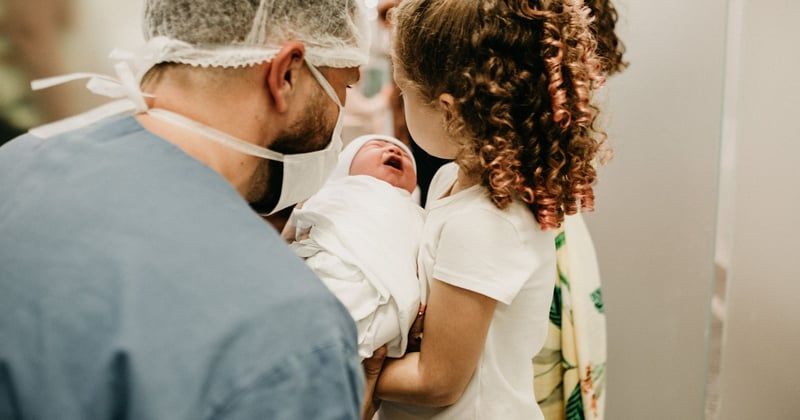
If you're giving birth in a hospital, the visit is the most important moment of the whole process — and it's the one most people leave to chance. Let your toddler visit if your hospital allows it (many do; some don't). If they visit, keep the meeting short and calm. Don't make them sit still. Let them touch the baby's foot if they want to.
A mistake I made was letting my daughter see me holding the baby first. She came in and I was already seated, baby in arms. She stood in the doorway and said nothing. If I could do it again, I'd put the baby down in the bassinet first, hand off the baby, and greet her with both arms open.
How to introduce a toddler to a new baby at home
Same principle applies at home. Whoever meets the toddler at the door should not be holding the baby. Your child needs to see that your arms still belong to them.
One more thing: it's fine to acknowledge that the baby is boring. "He doesn't do much yet. He just sleeps and cries" is a perfectly good line for a toddler. It's honest. It lowers the stakes.
How do I prepare my 2 year old for a new baby?
A two-year-old is working with a very short time horizon. Anything more than a few weeks away is basically a story. So you don't prepare them for "the baby." You prepare them for the small changes they'll feel — fewer hands available, more noise, someone sleeping in the next room.
- Use short, present-tense descriptions rather than future plans.
- Show them where the baby will sleep and let them help arrange something small (a blanket, a cardboard box that they can decide isn't for the baby).
- Don't rely on books to carry the whole message — they're useful, but they're conversation starters, not preparation on their own.
Books help, but names and pictures help more
Picture books featuring a "big brother" or "big sister" work best when your toddler has already heard the concept from you first. Otherwise they tend to treat the book as unrelated fiction. Which, honestly, is fair — a storybook about a baby is about as relevant to a two-year-old's life as a storybook about a farm.
And here's a specific tip that many people miss: talk about your own childhood, or make up stories about "when you were a baby." It anchors the idea of "baby" in something familiar. Your toddler feels ownership over their own babyhood instead of competition.
What is the 3-3-3 rule for toddlers?
The 3-3-3 rule is a parenting framework — not a scientific law — used to describe how a bigger sibling might settle into the new routine. The idea is that a child needs 3 days to acclimate to a new situation, 3 weeks to settle into it, and 3 months to really feel comfortable. It's a rough guide, and I'd treat it as a way to calibrate your patience rather than as an actual timeline you can hold your toddler to.
In my experience the "3 days" part is meaningless. The "3 weeks" part felt about right — that's roughly when the home dynamics stopped feeling like a crisis and started feeling like a routine. The "3 months" part is where things genuinely became normal.
What it does not mean
It does not mean your toddler will be "fine" in three days. It does not mean you can relax the extra attention after three weeks. It does not mean anything is wrong if your child needs more time. If your toddler is still shutting down or melting down constantly after three months, that's worth raising with your pediatrician — not because something is wrong with your child, but because extra support can help.
How long will it take my toddler to adjust to a new baby?
Real talk: for most toddlers it takes somewhere between four and eight weeks to settle into the new family shape, with regression and clinginess peaking around the first two to three weeks. Some children settle within a fortnight; others take three or four months. Both are within normal range.
What tends to shorten the adjustment period:
- Keeping your toddler's regular routine (same nap time, same bedtime, same bath order) as much as humanly possible.
- Giving one dedicated chunk of time each day where your toddler has your full, phone-in-another-room attention — even ten minutes.
- Not issuing new rules in the same month. Sleep training a toddler while welcoming a newborn is asking for trouble.
What tends to lengthen it: transferring your toddler to a big bed, starting a new daycare, or moving house in the same six weeks as the birth. I made the mistake of moving my daughter into a "big girl room" eleven days before my son was born. She spent the next five weeks getting up two or three times a night. I don't recommend this.
What is the 3 6 9 rule for babies?
The 3-6-9 rule refers to the general developmental stages of a baby: around 3 months they tend to start engaging more actively (smiling, tracking, settling into a rhythm), around 6 months they sit and start exploring food, and around 9 months many are crawling, pulling up, and becoming much more socially demanding. It's a useful mental model for parents because it tells you roughly when your toddler will start noticing the baby as a person rather than an object.

For sibling preparation, the 3-6-9 rule matters because your toddler's relationship with the baby evolves along a curve. Around month three, your toddler will start responding to the baby's smiles. By month six to nine, the baby can grab, reach, and provoke — which is when the real sibling dynamic starts. That's also when you'll want to start building the language of "gentle hands" and turn-taking, rather than trying to teach it all at the outset.
What it means for prep
It means you don't have to complete all the preparation before birth. You'll have a whole year of repeats after. Your toddler will get to know the baby's personality slowly and in their own way.
How to introduce a new baby to an 18 month old
At eighteen months, your toddler has almost no framework for "the future." Anything more than a week out is essentially abstract. Keep it concrete:
- Show them the physical baby items (crib, socks, tiny towels) — physical objects carry the message.
- Use simple phrases in present tense ("the baby is coming soon") rather than detailed plans.
- Make sure one caregiver is consistently their primary person for the first two weeks.
- Expect more than the usual amount of testing behavior — hitting, throwing, refusing food — without interpreting it as a sign of failure.
Realistic expectations
An eighteen-month-old may not be able to verbally express jealousy, but they will absolutely express it behaviorally. If your toddler suddenly wants to be carried everywhere, or starts using their baby voice, that's not manipulation — that's their nervous system telling them to check whether the old rules still apply.
Comparing common preparation strategies
| Approach | Best for | Main limitation |
|---|---|---|
| Picture books about new siblings | Children over 2.5 who already grasp the basic idea | Doesn't replace direct conversation; can feel abstract for younger children |
| Hospital visit with the new baby | Toddlers with stable temperament and a familiar caregiver present | Not all hospitals allow young sibling visits; can overwhelm |
| Practicing with a doll | Children 18 months to 3 years | Can create unrealistic expectations; needs to be playful, not instructional |
| Routine-first approach (no changes to sleep, daycare) | All toddlers | Requires advance planning that some families don't have |
| Assigning a small "big sibling job" | Older toddlers and preschoolers | Must be optional and genuinely trivial |
The part nobody warns you about
The hardest moment isn't the hospital visit or the first week home. It's the fourth week, when your toddler has accepted the baby exists but hasn't accepted that the baby has changed anything about their life — and then realizes it has. That's when the bellyaching, the regression, the sudden bedtime refusal show up, and that's when you're most tired.

Which is why preparation is only half the work. The other half is patience for a change that will feel, to your child, a bit like being demoted without a conversation. Give it time. Give your toddler their place. Give them a job that isn't actually necessary — like fetching a sock — and let them feel essential.
And someday, in a year or so, your toddler will hand you a diaper and tell you it's not for their toys. And you'll know exactly what they're doing.
Frequently asked questions
Should I tell my toddler about the baby early?
Not too early. For children under three, anything more than a few weeks out is abstract. Around four to six weeks before birth tends to work well.
Should I avoid changes to my toddler's routine during the last month of pregnancy?
Yes. Sleep, daycare, and bedroom changes are best done several months before birth or after the first two months have passed. Keeping the routine stable lowers the number of things your toddler has to process at once.
Will my toddler love the new baby?
Eventually. Immediate affection is rare and not a sign of anything. What matters is that your toddler feels secure enough to be curious, not competitive.