
My daughter was eight when she told me, with the flat certainty kids reserve for verdicts, that she hated reading. Not disliked. Hated. She'd just finished a "leveled" reader her school had sent home and the whole thing felt like homework wearing a disguise. What happened next took me by surprise, and it's the reason I now think most advice on this subject gets it backwards.
We stopped assigning books. We started finding ones she couldn't put down. Three years later she reads before school, after school, and sometimes under the covers with a flashlight—the flashlight was her idea, and honestly I didn't have the heart to confiscate it.
If you want to help your child develop a love of reading, the path isn't a stricter schedule or a longer book list. It's understanding what actually makes a child reach for a book when nobody is watching. That's what this is about.
Key Takeaways
- Reading for pleasure is built on choice, not obligation. A child who picks the book is far more likely to finish it.
- The 5 finger rule helps you check whether a book is at the right level: have your child read a page aloud and count the words they stumble on.
- Fluency and comprehension live on different tracks. A child can read every word and still not love it.
- Comics, magazines, and instruction manuals count. So does reading the same book twelve times.
- Screens don't have to be the enemy—what matters is what replaces them, not how hard you fight them.
How can I support my child to develop a love of reading?
Here's the uncomfortable part: most of what we do as parents is designed to make children able to read, not want to read. Those are different projects, and the second one gets far less attention. A child who can decode words perfectly but never chooses a book has learned a skill and lost the point.
Supporting a love of reading means shifting your role. You're no longer the teacher with a lesson plan. You're the person who finds the right book at the right moment and then gets out of the way.
Follow the lead, not the reading list
When my son went through a phase where the only thing he'd read was a battered guide to Minecraft redstone circuits, I cringed. It wasn't literature. It had no plot, no characters, and a font that looked like it was designed on a lunch break.
Then I noticed something. He was reading for forty minutes straight. Unprompted. Nobody had asked him to. That guide taught him more about persistence than any chapter book I'd pressed on him.
Interest is the engine. Everything else is fuel you add later.
Make reading a choice, not a chore
The single fastest way to kill a reading habit is to turn it into something that gets checked or graded. I made this mistake with my daughter. I'd ask how many pages she'd read, and within two weeks she'd started lying about it. Not because she was dishonest—because the question had turned a pleasure into a performance review.
What worked instead:
- Letting her abandon books she didn't like, no explanation required
- Keeping a basket of options visible in the living room, not hidden on a shelf
- Reading my own book in the same room, without commentary
- Never asking how many pages
The last one was hardest and mattered most.
Read aloud longer than you think you should
Most parents stop reading aloud once the child can read independently. This is a mistake I'll defend to the end. A child's listening comprehension runs ahead of their reading comprehension by several years. When you read a story above their level, you're not confusing them—you're showing them what's waiting on the other side.
My daughter was eleven before she'd let me stop reading to her at night, and she only stopped because she'd started reading ahead without me.
What is the 7 7 7 rule for kids?
You've probably seen this one floating around. The 7 7 7 rule for kids is a loose framework, not a strict law, and it comes in a few versions depending on who's explaining it. The most common reading-related version goes something like this: read for roughly seven minutes at a time, aim for around seven pages, and give the habit about seven days to take hold before you judge whether it's working.

I'll be honest—when I first heard it, I rolled my eyes. It sounded like a slogan invented by someone with a book to sell.
But there's something worth keeping in the idea. Seven minutes is short enough that a reluctant reader won't fight it. Seven pages is a concrete, finishable target instead of a vague "read more." And seven days is long enough to notice a pattern without demanding a permanent commitment.
How to use it without turning it into a rule
Treat 7 7 7 as a starting point, not a scoreboard. The point is to lower the barrier so low that saying no feels sillier than saying yes. I used it with my son during a stretch when he'd drifted away from books entirely. Seven minutes before bed. That was the deal.
Two weeks later he was asking for "one more minute," which is the whole trick.
Caveat: different sources describe this rule differently, so if you see a version that involves something other than reading, don't assume one of you is wrong. It's a flexible idea, not a scientific law.
What is the 5 finger rule for reading?
This one is genuinely useful and I wish more parents knew it. The 5 finger rule for reading is a quick way to check whether a book is at the right level for your child. Open to any full page of text, have your child read it aloud, and count how many words they stumble on or can't decode.

- Zero or one finger: the book is too easy—fine for confidence, but it won't stretch anything
- Two or three fingers: just right. This is the sweet spot for independent reading
- Four fingers: a challenge, best read together
- Five or more: too hard for now, save it for later
Why this matters: a child who's constantly handed books above their level learns that reading is a struggle they keep losing. A child handed books slightly below their level gets bored. The window in between is narrow, and the finger rule finds it in about thirty seconds.
The limits of any leveling system
I need to say this plainly, because I've watched it backfire. Leveling is a tool, not a verdict. My daughter spent a year convinced she was "a level M reader," which meant nothing to her except that certain books were off-limits. She internalized a label instead of a love.
Use the finger rule to guide choices. Never use it to forbid one.
Screens aren't the villain you think they are
Every conversation about kids and reading eventually turns into a fight about screens. I've had it, you've probably had it, and I think the framing is wrong.
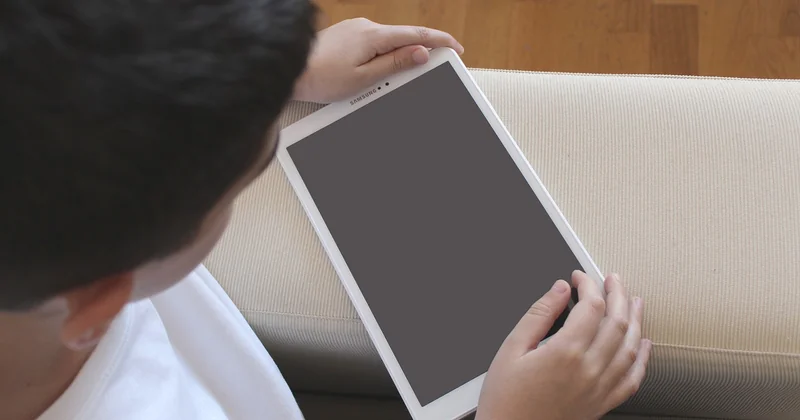
The question isn't "how do I get my child off screens." It's "what am I offering as an alternative." A child with nothing to do and a tablet nearby will pick the tablet every time. A child with a book they actually want to read and a tablet nearby is a coin flip.
A few things I've observed in my own house and in dozens of other families:
- Screen time doesn't replace reading if reading is already a habit—but it fills the vacuum when it isn't
- Bedtime is the easiest slot to protect. Screens off, lights dim, books out. This has worked in every family I know who's tried it
- E-readers and audiobooks are not cheating. My son listened to eleven audiobooks last year and read four. That's fifteen stories he wouldn't have encountered otherwise
- Modeling matters more than rules. If you scroll at dinner, your kid will scroll at dinner
I'm not going to pretend screens are harmless. But treating them as the enemy gives them power they don't deserve, and it turns reading into the consolation prize. That's a losing pitch to any child old enough to negotiate.
How to raise kids that love reading
The families I know whose kids read for pleasure all share a few traits, and none of them involve flashcards or reading logs.
| What helps | What backfires |
|---|---|
| Books visible and reachable everywhere | Books locked in a tidy shelf nobody touches |
| Letting the child pick, even badly | Assigning titles based on "quality" |
| Reading aloud past the point of "needing" it | Stopping the moment they can read alone |
| Treating comics and audiobooks as real reading | Insisting only "proper books" count |
| Adults who read in front of them | Adults who only ever mention reading as a duty |
The window nobody talks about
There's a stretch—usually somewhere between ages nine and twelve—where reading quietly falls off a cliff for a lot of kids. Not because they can't, but because their interests explode and the reading material on offer doesn't keep up. This is when a lot of parents panic and push harder.
Pushing is the wrong move. Widening is the right one.
Graphic novels. Sports biographies. Weird nonfiction about disasters. A magazine about guitars. Anything the child would actually choose. My daughter went through a four-month stretch where she read nothing but books about animals rescuing people, and her vocabulary jumped noticeably. I didn't love the genre. She did. That's what mattered.
What to do when nothing works
Sometimes you'll hit a wall. Your child refuses everything, the library trips feel pointless, and you start wondering if you've done something wrong.
A few things worth trying, in rough order:
- Lower the bar dramatically. Five minutes a day. That's it. Make it so easy they can't object
- Change the format. Audiobooks, magazines, graphic novels, a cookbook, a game manual
- Change the venue. Some kids read in the car. Some read in a hammock. Some read in a pillow fort
- Stop watching. A watched reader never relaxes. Give space, and let curiosity do the work
- Talk to their teacher or librarian. Sometimes an outside recommendation lands where a parent's doesn't
And if it still doesn't click? Wait. I've watched more than one child come back to reading at fourteen after years of nothing. The habit is patient. You can be too.
A thought to end on
The flashlight under the covers told me something I'd been missing for years: my daughter never hated reading. She hated being managed while doing it. Once the management stopped, the reading started. It just took me longer to notice than it should have.